
Berkeley Previous Residents by Record Era
A backward address search in Berkeley Township pulls from several record streams. Their dates rarely line up. The Ocean County deed index has a stated starting point online. Telephone books cover only selected runs of years. The Library of Congress directory guide lists its own gaps. Match the source to the era you need. Keep the source date attached to every name you collect. The County Clerk remains the custodian of recorded land. A directory or newspaper can reveal a household clue no deed will show.
| Source | Years it covers | Where held | What it can show |
|---|---|---|---|
| Ocean County deed index | April 1, 1977-present index stated | Ocean County Clerk | Instrument chain, parties, date, book or page, consideration, and parcel fields |
| County deeds and Archives holdings | Deeds through 1900 described on microfilm | New Jersey State Archives and FamilySearch | Older deed books, legal descriptions, and predecessor-jurisdiction evidence |
| OCHS telephone directories | 1956-57, 1970-2007, 2010, and 2014 | Ocean County Historical Society | Dated telephone and address entries |
| LOC Ocean County directories | 1970-2000, with five listed missing years | LOC guide and item holdings | Annual address or occupant clue, subject to issue verification |
| OCHS newspaper index | 1852-1968 | Ocean County Historical Society | Obituaries, marriage or birth notices, and local address references |
| Federal census | 72-year public-release rule | NARA, library databases, or OCL | Household, age, relationship, occupation, and place data, not a current address |
Berkeley assessment and permit portals can anchor a current parcel. Neither system offers a historical online range. Once the web trail runs cold, an older record becomes a request or library-and-archives problem.
Start Berkeley Previous Residents With a Parcel
A Berkeley Township lookup starts with the parcel, not the name. First keep three things separate. There is the tax situs, the mailing address, and the party address on a recorded instrument. They do not always match. The Ocean County Tax List Search lets you query by Municipality, Block, Lot, Qualifier, and Property Class. Property Location works as a query field too. Pick Berkeley itself as the municipality. Skip the shortcut of trusting a ZIP or a mailing-city label. Mail routes can mislead a past-residents search. A matching record can carry assessment and sale-history detail. That detail includes book and page, deed date, grantor, grantee, sale price, and record date.
From there, pair two sources. The Ocean County GIS hub shows parcel geography, municipal boundaries, tax maps, and aerial imagery. It also covers zoning, flood zones, wetlands, and streams. The County Clerk holds the recorded instrument itself. When you open the viewer, note each layer's name. Note its data date too, rather than guessing at field labels. The county lists a 2025 Parcel and MOD-IV geodatabase. The building-footprint layer carries a 2015 date.
Note: A tax mailing address alone is not proof of residence at the parcel. A deed party address is not proof either.
Berkeley Previous Residents and the 1977 Cutoff
The Ocean County Official Records Public Search is the core index for recorded instruments, and its stated coverage begins April 1, 1977. That date is the hard cutoff for a fully online Berkeley Township residents directory built from deeds. You can search by document type, town, date range, party name, instrument number, book and page, block and lot, legal description, map, and parcel. Results are marked unofficial and watermarked, so treat them as leads. Try surname variants. Always open the actual instrument before calling an index entry final evidence.
A typical result shows instrument type and number, date, book type, book or page, page count, consideration, map or parcel identifiers, parties, and status. An online hit is a bridge to the document, never a substitute for it. For confirmed copies, contact the Ocean County Clerk at 118 Washington Street in Toms River, or call 732-929-2018, and ask about the exact instrument, format, and current fee.
Older deeds take a different path. The State Archives holds county deeds on microfilm through 1900, and county deeds are digitized on FamilySearch. Confirm the exact image, volume, page, and citation instead of assuming every earlier transaction sits in the same online interface.
Tracing Berkeley Previous Residents Through Deeds
A chain of title lists every recorded transfer for one parcel. It tracks ownership, not occupancy. Someone can appear in a deed yet never have lived in the house. Treat the chain as a starting map rather than a full roster of past residents. Begin with a tax or assessment record. That gives you the block, lot, qualifier, and legal description. Take those details to the Clerk index. Locate the most recent purchase you know of. Pay close attention to buyer and seller roles. Each seller was once a buyer. Repeat the step through their earlier acquisition and the chain builds backward. Expect gaps at the index cutoff and from shifting names or parcel descriptions.
- Use the Berkeley assessor or Ocean County tax route to record the municipality, block, lot, qualifier, situs, and any visible sale-history reference.
- Search the current owner or party in the County Clerk index, using the parcel and document date where available.
- Open or request the instrument and identify the seller, buyer, date, instrument number, book or page, and legal description.
- Search the prior seller as a grantee to locate that person’s purchase, then repeat the same source-labeled step.
- When the chain reaches the pre-April 1977 online boundary, move to the Clerk, State Archives, FamilySearch, or a defined archival request.
- Grantor and grantee
- The grantor transfers an interest in a document. The grantee receives that interest.
- Chain of title
- The dated series of recorded ownership transfers connected to one parcel or legal description.
- Legal description
- The parcel description used in recorded land documents. It is often more durable than a street address for older research.
Berkeley Previous Residents in Local Collections
Once the land trail identifies a time period, the Ocean County Historical Society can help locate household evidence. The Richard L. Strickler Research Center holds phone books, yearbooks, newspaper material, obituaries, funeral and Bible records, cemetery material, family files, maps, surveys, and miscellaneous deeds. It is at 26 Hadley Avenue in Toms River and is open Tuesday, Wednesday, and the first Saturday from 1 to 4 p.m. Materials are noncirculating and staff retrieve them.
Remote research is another documented channel. The Society lists a full volunteer search at $15 for nonmembers and $5 for members; a specific obituary, funeral record, or Bible record search is listed at $5. Those fees and the available scope should be confirmed with the Research Center when submitting a request. A request that gives a name variant, address, approximate year, and record type is more likely to produce a source that can be checked.
The Ocean County Historical Society Research Center is the official starting point for that staff-assisted route.
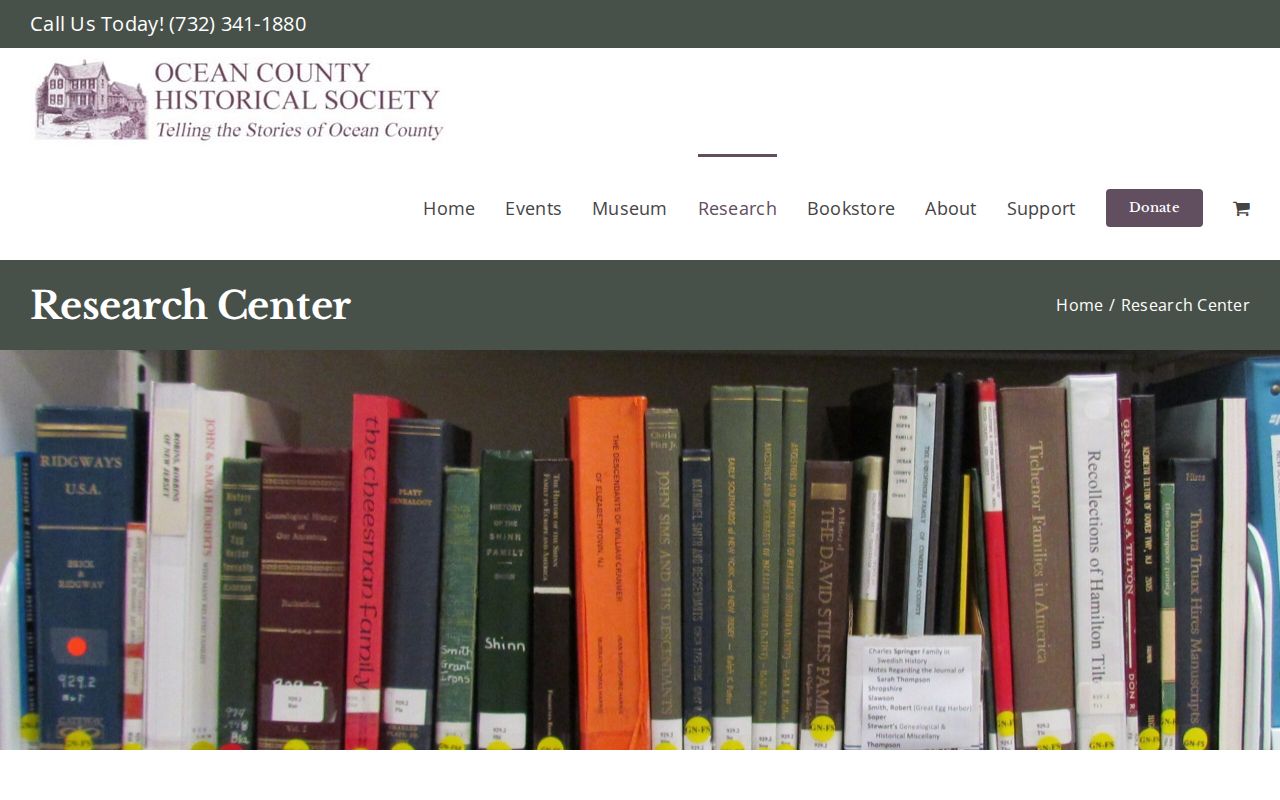
The Research Center is especially useful when a dated phone book, obituary, family file, or newspaper notice can test a household clue from the property trail.
Berkeley Past Households in Directories and Census
Deeds tell you who bought and sold, not always who lived there. A stronger household trail in Berkeley Township starts with dated phone books. The Ocean County Library and OCHS hold the city directories. Pair a directory line with a census record, an obituary, or a probate file. The Library of Congress maps Ocean County directory coverage from 1970 to 2000. Gaps fall in 1975, 1977, 1983, 1985, and 1995. For deeper background on those collections, see the Berkeley Township city directory page.
A criss-cross directory works in reverse. It is arranged by street address. From a house or business line you can pull a listed household. It never counts as a complete occupancy record, though. Note the title, year, page, city line, spelling, and any notation. Then check the next year. The Ocean County Library city-directories catalog shows each title and its format. Check it before you visit or place a request.
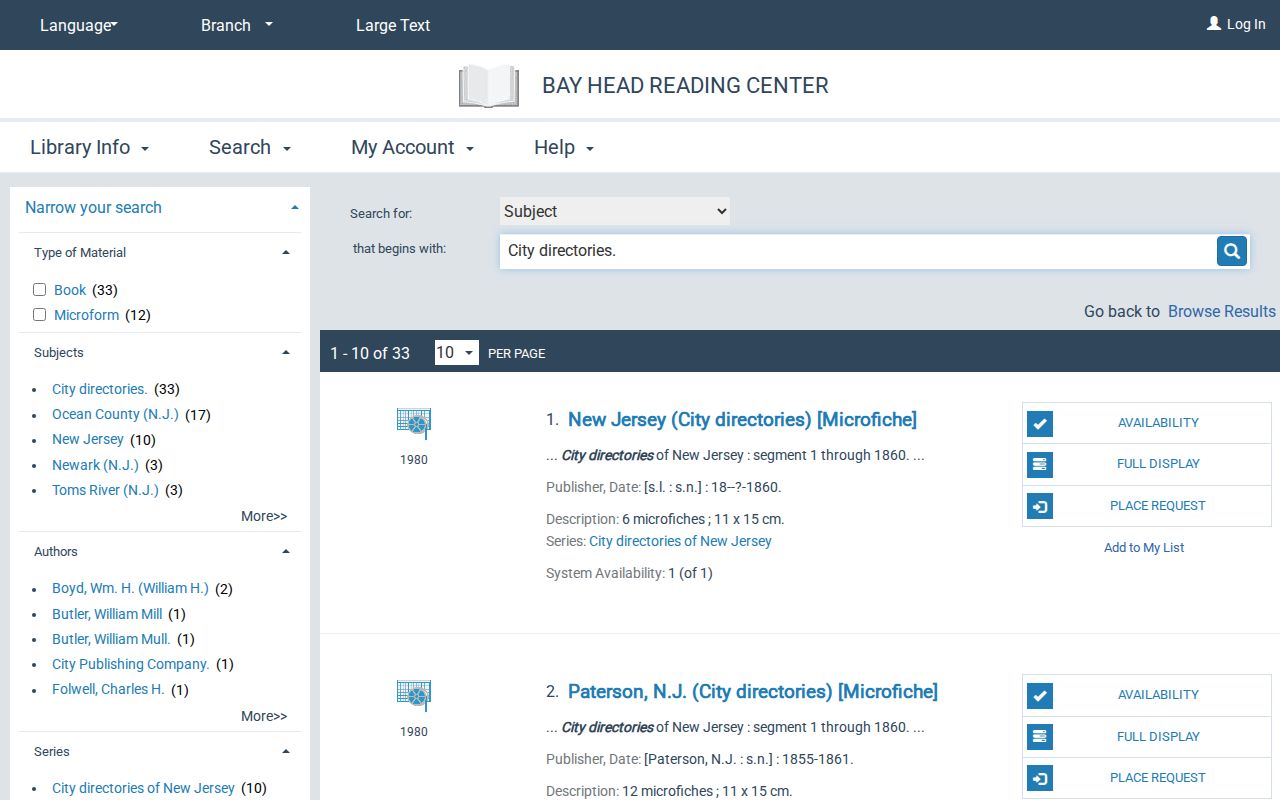
The catalog browse returns 33 subject records and 12 microform records. Those counts help discovery only. They do not prove a complete annual run.
Follow one record flow: address, then directory year, then census year, then obituary or probate source. Each link needs its own date and citation.
Berkeley Previous Residents Before 1875
Berkeley Township split from Dover Township in 1875. That matters for any past-residents search. A record from the old days may sit under Dover, under Ocean County, or even under Monmouth County from an earlier era. Berkeley land later broke away to form Seaside Park, Seaside Heights, Beachwood, Ocean Gate, Pine Beach, South Toms River, and other successor towns. The jurisdiction printed on an old record is a search term. Treat it as a clue, never a defect to fix.
The OCHS project Families of Old Dover draws on the 1850 county census and related sources. It covers 1,793 households across 604 head-of-household surnames, with 229 booklets spanning 1,529 households. That reconstruction is a strong lead generator for families and places around the township's founding. Proof still requires original census, cemetery, church, probate, deed, or newspaper material.
Note: Keep the jurisdiction and address exactly as printed, and record any modern normalized location in a separate research note.
Sanborn Maps and Berkeley Address Gaps
Fire-insurance maps date a building's physical setting. They do not prove who owned or occupied it. The Library of Congress Sanborn research guide allows searches by state, city, and date. Sheet numbers, map notes, and digital links are searchable too. No Berkeley Township or Bayville sheet appears in the official text search. Treat that as an open gap rather than proof that none exists.
Nearby Ocean County maps only show how the system works. Tuckerton, Lakewood, and Barnegat sheets are examples. Never label one of those as a Berkeley map. If a Berkeley or Bayville sheet surfaces, save the printed place name, year, and volume. Record the sheet number, scale, page detail, and Library of Congress permalink as well. Then pair it with a tax map, legal description, or deed. A Sanborn sheet alone is not an address history. Check the Library of Congress Sanborn guide before making a targeted map request.
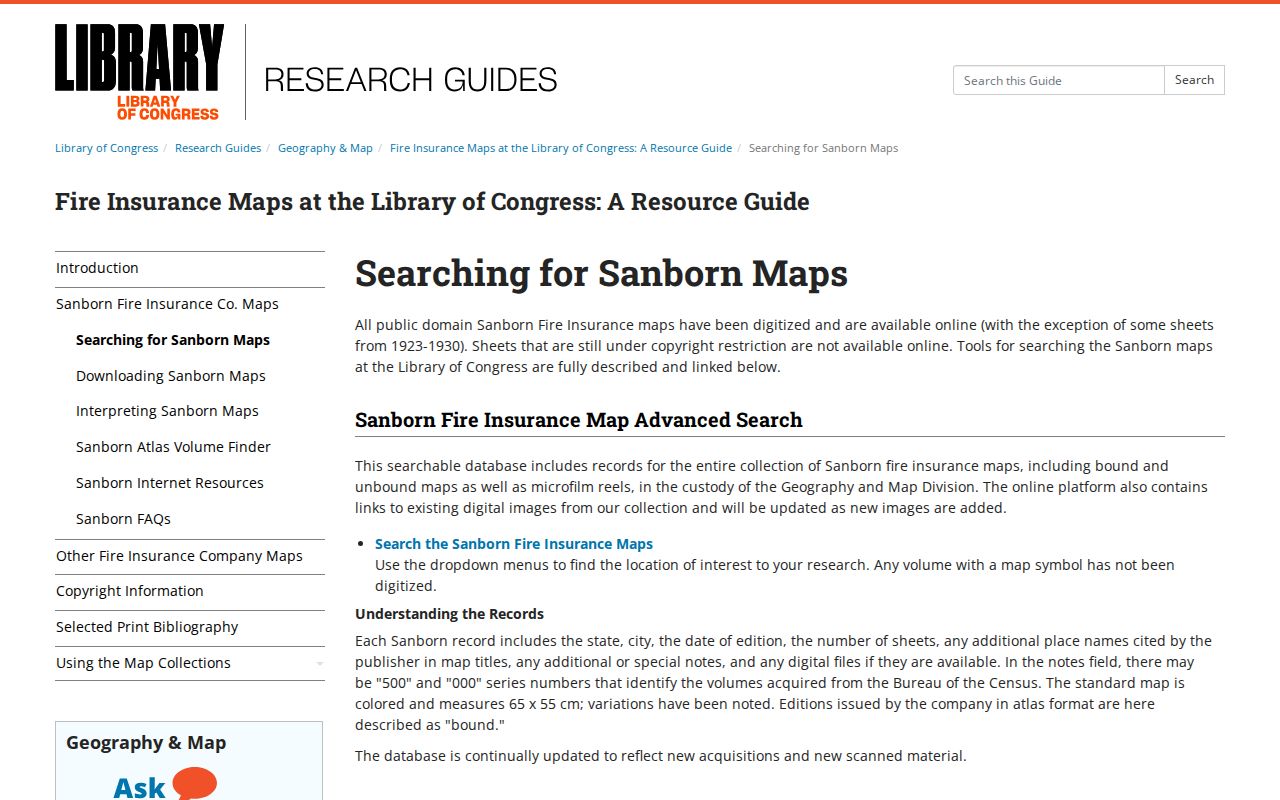
The guide shows the official map-search path while leaving the Berkeley or Bayville sheet question open.
Berkeley Past Households, Obituaries, and Limits
Obituaries, cemetery files, probate, and local newspaper indexes can settle a historical household trail. OCHS maintains a local-newspaper index for births, marriages, and deaths covering 1852 through 1968. Its collections also hold Dover probate, cemetery, funeral, Bible, and family-file resources. A relationship, a death, or a move often becomes clear through them. Cite each item to the original notice or repository record where you can.
Some records simply will not name who lived at a property. Address data may be incomplete for several reasons. These include the New Jersey Address Confidentiality Program, Daniel's Law redaction, sealed records, a different custodian, or an unindexed source. A missing result never justifies rebuilding a protected address from indirect clues. For permit or code history, Berkeley points routine searches to the SDL Portal. Its live fields and coverage are not summarized here. So request a defined record if the portal does not answer your date question.
Lawful use. Berkeley previous-resident research is for family and house history, estate questions, and personal curiosity. Do not use public records to track, threaten, contact, or harass any living person.